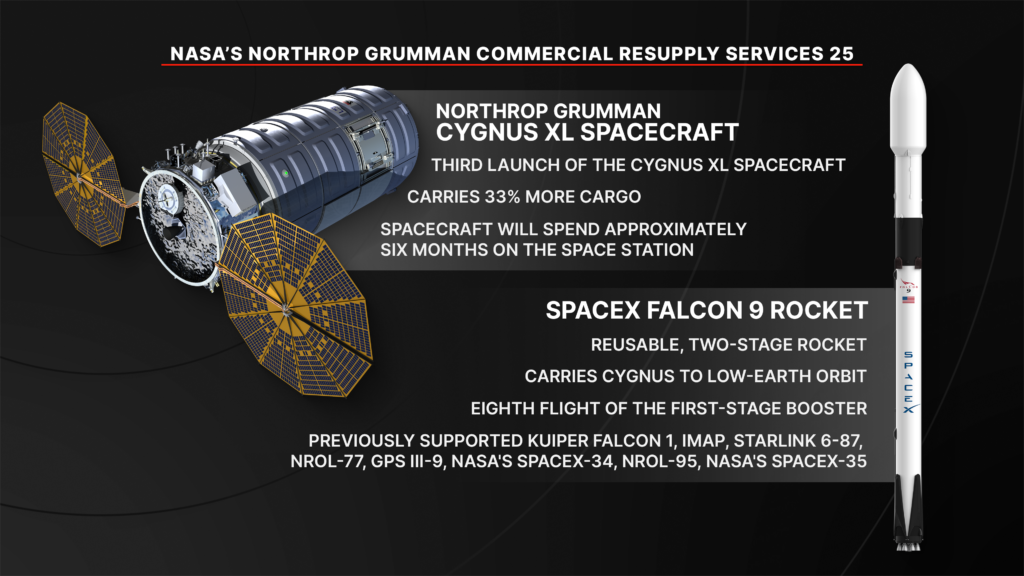
NASA and Northrop Grumman are preparing to launch the Commercial Resupply Services 25 mission (Northrop Grumman CRS-25), sending approximately 11,000 pounds of research, equipment, and supplies to the International Space Station. The mission represents the third flight of Northrop Grumman’s Cygnus XL spacecraft, a larger, more cargo-capable version of the solar-powered vehicle. Cygnus XL will lift off aboard a SpaceX Falcon 9 rocket from Space Launch Complex 40 at Cape Canaveral Space Force Station in Florida. Upon arrival, NASA astronauts Jessica Watkins and Luke Delaney will manage rendezvous operations, with Watkins operating the Canadarm2 robotic arm to grapple the vehicle while Delaney monitors its approach. Ground controllers will then robotically attach the spacecraft to the Earth-facing port of the station’s Unity module. The spacecraft is named in honor of NASA astronaut James “Jim” A. Lovell Jr., who flew on Gemini VII, Gemini XII, Apollo 8, and Apollo 13.
What medical and biological research is aboard?
The mission delivers multiple scientific investigations, including the Advancing Therapeutic Treatment of Sarcopenia (Cardinal Muscle 2.0) study from the Palo Alto Veteran’s Institute for Research. Using a Biocell bioreactor system, Cardinal Muscle 2.0 tests engineered human muscle tissue samples in microgravity to determine whether existing Food and Drug Administration-approved drugs can be repurposed to prevent or reduce muscle loss. The findings aim to accelerate treatments for age-related muscle decline on Earth and support crew health on long-duration spaceflights.
Another medical study, Biomimetic Fabrication of Multi-Functional DNA-Inspired Nanomaterials via Controlled Self-assembly in Space (DNA Nano Therapeutics-Mission 2), or DNA NANO B, is conducted by the University of Connecticut. The project investigates in-space manufacturing of Janus Base Nanoparticles (JBNp) that deliver bioactive mRNA into dense human tissues, such as cartilage and solid tumors. Microgravity provides an environment for more uniform particle self-assembly, which could advance targeted therapies for osteoarthritis, cancer, vaccines, and regenerative medicine.
Cancer research on the flight also includes Encapsulate nVasive: Unraveling the Enigma of Metastasis – Flight 1 (ENCAPSULATE-1) from Encapsulate Inc. The project grows microtumors from patient samples inside a specialized biochip to monitor how cancer cells move, invade surrounding tissues, and interact in microgravity. Researchers hope to develop a diagnostic tool capable of predicting cancer progression and metastasis risk months or years in advance to personalize patient treatments.
How will the mission support future lunar and deep space exploration?
Technology demonstrations on CRS-25 focus on operational safety and infrastructure for future exploration. The Active Radiation Environment Sensor (ARES), developed by NASA and HHPC, will undergo validation on the station. ARES provides real-time radiation monitoring inside crew living quarters and includes warning capabilities for Human Landing System crews supporting the Artemis program and lunar missions.
For deep space food production, the mission carries OHALO III, a plant growth facility developed by Utah State University and NASA’s Kennedy Space Center. The module utilizes Utah Re-usable Root Modules alongside automated water recovery and air exchange systems to optimize plant water delivery and volume utilization, informing future agricultural design decisions for crew missions to Mars.
In-space manufacturing and assembly will be tested via the JOining demonstrations IN-Space (JOINS) project from Lockheed Martin. Located inside the Bishop Airlock, JOINS will perform autonomous robotic welding on aluminum and stainless-steel samples using two distinct methods: high-precision laser beam welding, which melts and fuses metals, and friction stir welding, which uses a rotating tool to soften and join materials. The technology aims to enable large-scale construction for infrastructure such as Moon Base without launch vehicle size constraints.
What hardware and crew supplies are included?
In addition to scientific payloads, the Cygnus XL spacecraft carries crew quarter replacement blankets and covers, hatch seal covers for the U.S. segment, and batteries for the Anomaly Gas Analyzer sensors. The manifest also includes a modified toilet pretreat hose required to operate the universal pretreat concentrate tank within the station’s Universal Waste Management System toilet, as well as specialized spacewalk tools designed for upcoming maintenance on the Alpha Magnetic Spectrometer.