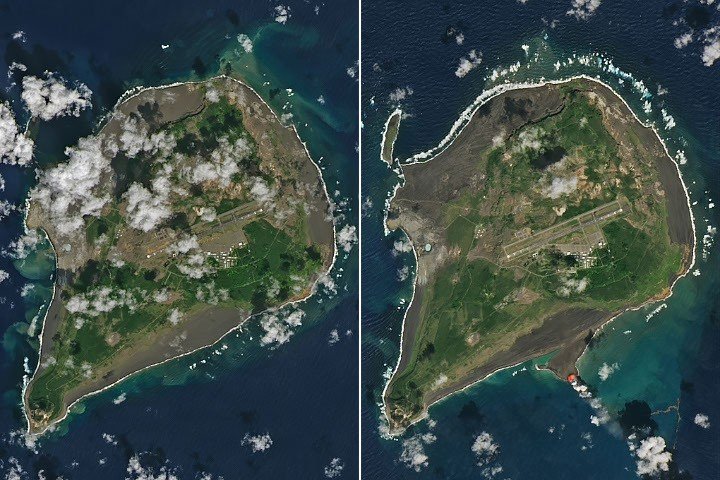
A volcanic eruption in the shallow waters near Iwo Jima has extended the Japanese island’s black sand beaches, adding roughly 50 hectares (125 acres) of new land—about the area of 90 American football fields—and enlarging the island by approximately 1.7 percent, according to satellite observations and a Nov. 16 report by Japan’s Coast Guard.
Signs of volcanic unrest began in late October 2026. On Oct. 27, seismic sensors recorded a sharp uptick in activity, and Japan’s Meteorological Agency reported that the first photographs of the eruption were captured. Satellites quickly began gathering data on the undersea event. The Operational Land Imager (OLI) on Landsat 9 observed a quiet coast on Oct. 26 before obtaining its first clear view on Nov. 11 of the new land built by the submarine volcano.
In the Landsat 9 imagery, a shortwave-infrared heat signature appears in orange, while a faint gray volcanic plume drifts southeast of the vent alongside a streak of floating pumice. Earlier backscatter radar imagery from the NISAR (NASA-ISRO Synthetic Aperture Radar) satellite detected a large water disturbance on Oct. 28 in the same site that erupted in December 2023. As clouds cleared in early November, the MODIS and VIIRS sensors on NASA and NOAA satellites also recorded the eruption’s volcanic plumes and infrared signature.
The newly formed land adjoins the southeast beach where American troops landed on Feb. 19, 1945, starting one of the bloodiest battles in U.S. Marine Corps history. The eruption’s location came as no surprise to scientists; Daniel Slayback, a scientist at NASA’s Goddard Space Flight Center, noted that Iwo Jima also experienced an eruption off its west coast in August 2025 in addition to the December 2023 event.
How long the new land will persist remains an open question. Slayback stated that land created by the 2023 eruption succumbed to wave action after just a few weeks. He added that new land formed on volcanic islands has survived for more than a decade in only a handful of recent instances, including at Capelinhos, Surtsey, McDonald Island, and Home Reef.
“I imagine we’ll see this new land wash away within a few months,” Slayback said. “But we’ll have to wait and see.”
James Garvin, chief scientist at Goddard and a geologist studying underwater volcanic landforms, explained that tephra-dominated eruptions typically produce new land that is quickly attacked by ocean waves and hydrologic forces. An exception occurs if the eruption injects specific types of lava that cement the ash into stronger material.
“If we do see injection of basaltic-andesitic lava within the new materials, then it’s possible the new land could follow a pattern different from what we monitored in 2023,” Garvin said.
Garvin noted that NISAR will be especially valuable for tracking the site, as its frequent, high-resolution interferometric radar observations penetrate cloud cover to show whether the land erodes, subsides, or grows. The satellite registered major changes at the site between Oct. 28 and Nov. 11. NASA scientists will also analyze sub-meter-resolution images from commercial satellites via NASA’s Commercial Satellite Data Acquisition Program to identify subtle deformation features like rilles, fractures, and cracks.
Both Slayback and Garvin previously monitored new land formation in the Kingdom of Tonga following a Southwest Pacific eruption, prior to most of it being destroyed during the explosive Hunga Tonga-Hunga Ha‘apai caldera collapse and eruption in January 2022.