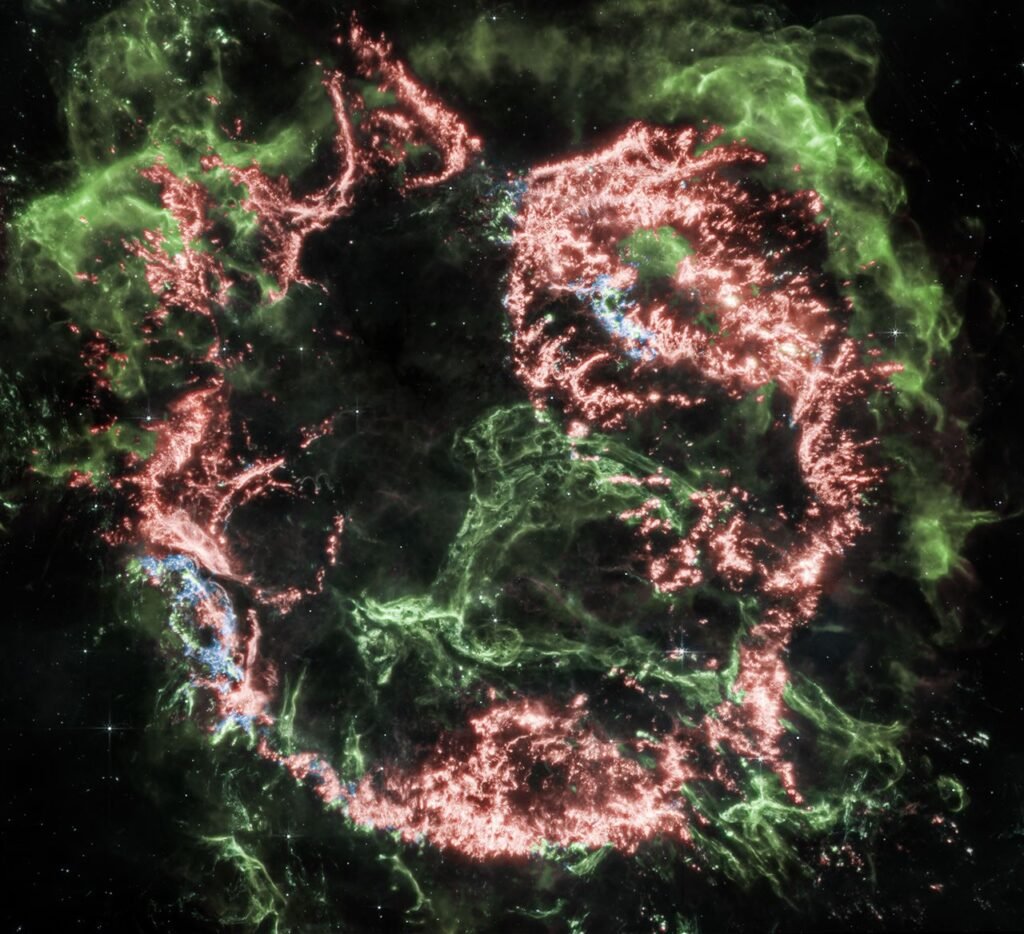
NASA’s James Webb Space Telescope has captured a detailed view of the supernova remnant Cassiopeia A (Cas A). These remnants, composed of gas and dust clouds left behind by a massive star’s explosion, serve as the building blocks for future stars and planets. The high-resolution, mid-infrared data from Webb provides new insights into the structure and evolution of the star that created Cas A. The findings, published Monday in The Astrophysical Journal Letters, suggest the star’s interior underwent significant changes shortly before its collapse.
Stars originate from molecular clouds of hydrogen and cosmic dust that collapse under gravity to form protostars. As these stars mature, they fuse hydrogen into helium, and eventually, heavier elements in their cores. This process creates distinct shells of elements, which act as a historical record of the star’s evolution. When a supernova occurs, these elements are ejected into space, where they condense into dust grains.
By mapping the composition of solar-system-sized dust clumps within Cas A, researchers discovered evidence of a shell merger, where internal layers mixed before the explosion. “Material within these shells churns and circulates, which can cause the shells to merge shortly before the supernova explosion,” said Tea Temim, lead author of the study and research scientist from Columbia University in New York. “So, for example, the oxygen- and carbon-burning shells in a star merge together and change the structure of the star significantly. And that would then change the chemical abundances that you would see after a supernova explosion in the ejecta of a supernova remnant.”
To guide Webb’s observations, researchers utilized data from the retired Spitzer Space Telescope to identify three specific regions. Two targets were located within the reverse-shocked region of Cas A, where inward-moving shock waves collide with outward-moving debris. Webb found that one region was dominated by silica dust, while the other contained mostly carbon dust. The third target, known as the “Green Monster,” was found to be rich in complex magnesium silicates, originating from material the star shed prior to its explosion.
The study also incorporated X-ray observations from NASA’s Chandra X-ray Observatory and the JAXA-led XRISM to map the dust composition across the entire remnant. These combined datasets indicate that the shell merger occurred shortly before the supernova event. “With Webb, the vast improvement in being able to resolve at the individual clump level helps us do more sophisticated dust chemistry,” said Dan Milisavljevic, associate professor and co-author of the study from Purdue University in West Lafayette, Indiana. “As a result, we can tie the explosion back to the makeup of the progenitor star hundreds of years afterward. It’s telling us about what was happening, we think, in the hours leading up to core collapse. Understanding this process is essential to explaining which elements the supernova explosion will release into the galaxy and how those elements enrich future generations of stars and planets.”