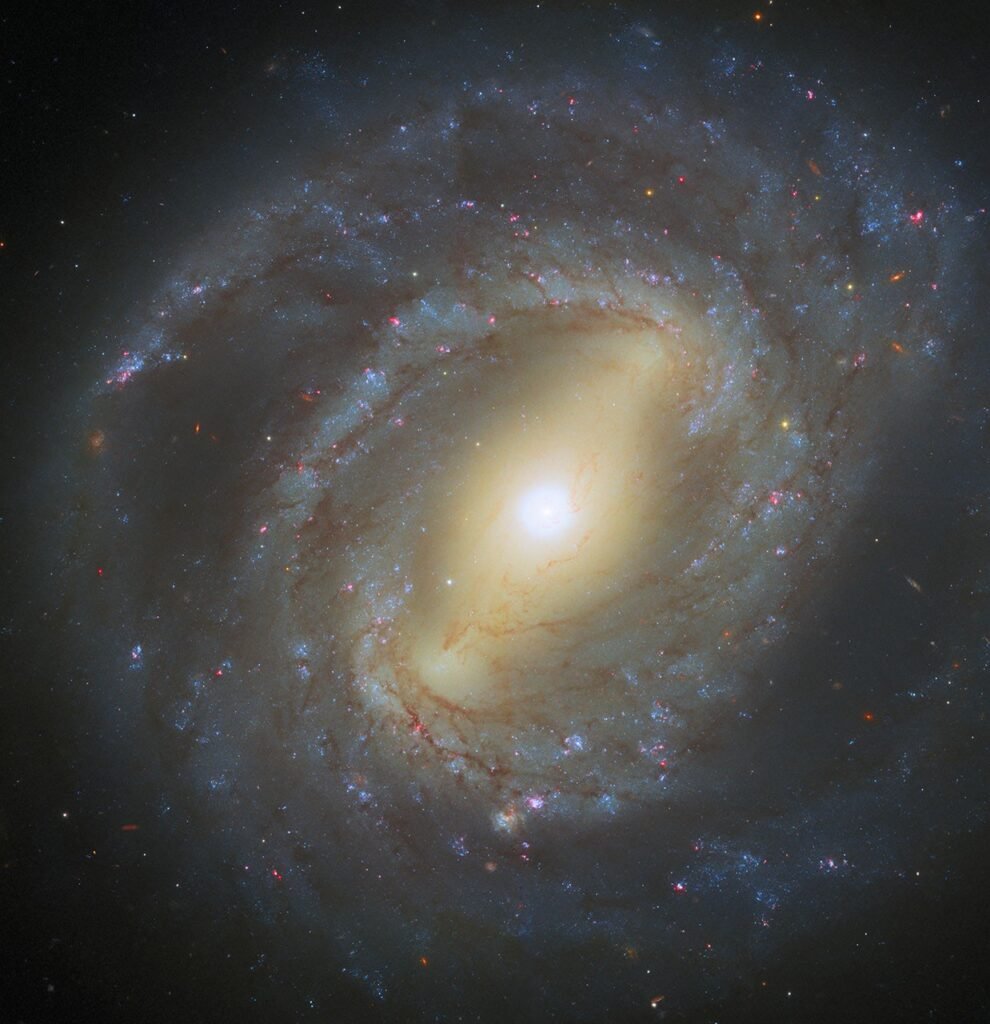
A newly released image from the NASA/ESA Hubble Space Telescope highlights NGC 4394, a brilliant galaxy located about 55 million light-years away in the constellation Coma Berenices (Berenice’s Hair). Positioned within the Virgo Cluster—the galaxy cluster closest to Earth, containing more than 1,000 galaxies—NGC 4394 features graceful spiral arms and a prominent central bar of stars, closely resembling how astronomers envision the Milky Way when viewed from a face-on vantage point.
In a universe filled with arcing spiral galaxies and organically shaped nebulae, straight streaks of stars like the galactic bar of NGC 4394 stand out. Astronomers estimate that 65 percent of nearby spiral galaxies feature a galactic bar. Hubble has previously captured other barred spiral galaxies, including NGC 5728, NGC 685, and NGC 613, as scientists seek to understand how these striking features form.
Explanations for galactic bar formation suggest a galaxy’s stellar disk becomes unstable due to gravitational nudges from passing galaxies, interactions between stars, or other forces. Once unstable, the circular orbits of stars elongate into a barred shape. Observations indicate that galactic bars are more common in today’s universe than they were several billion years ago, though research suggests these features are temporary, as growing bars can eventually become unstable themselves.
NGC 4394 and the Milky Way galaxy also share another potential similarity: both may contain a low-ionization nuclear emission-line region, known as a LINER. Located near the center of a galaxy, a LINER is an area where spectra show specific ionized or neutral elements. While the exact formation mechanism remains unknown, researchers believe either hungry supermassive black holes or intense star formation likely plays a role.
Hubble previously photographed NGC 4394 in an image released a decade ago under an observing program (#10515; PI: Peng) focused on its galactic neighbor, Messier 85. While one instrument observed Messier 85, Hubble’s Advanced Camera for Surveys captured NGC 4394 in a parallel region of the sky. The new composite image combines those earlier views with data from a recent program (#18103; PI: Thilker) examining how star formation ceases in galaxies within dense cluster environments compared to isolated galaxies adrift in the field.
For the recent study, researchers utilized Hubble’s Wide Field Camera 3 and its broad wavelength sensitivity to determine the ages of individual star clusters, studying NGC 4394 as one of 40 galaxies in the program. Text credit for the release is attributed to ESA/Hubble, with media contact Claire Andreoli at Goddard Space Flight Center in Greenbelt, MD (claire.andreoli@nasa.gov), and editing by Andrea Gianopoulos following an update on Nov 24, 2026.