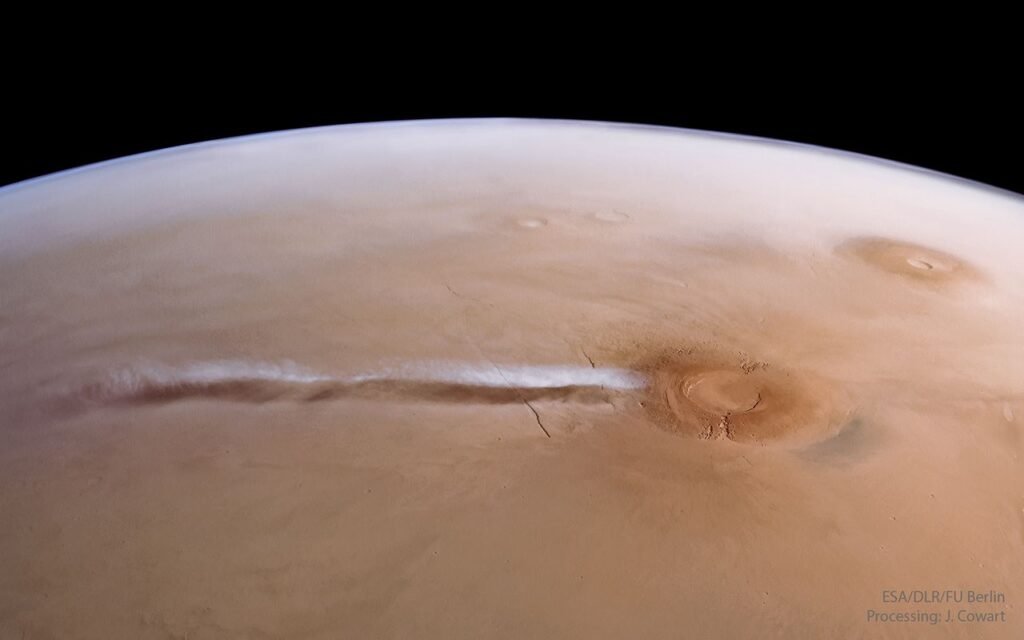
An unusually long cloud on Mars, known as the Arsia Mons Elongated Cloud (AMEC), has been the subject of ongoing scientific study since it was first recorded by NASA’s Viking Orbiter 2 in 1977. More recently, the European Space Agency’s (ESA) robotic Mars Express spacecraft has captured the cloud in greater detail, including a featured image from 2018.
The cloud forms exclusively during the spring and summer seasons and only appears during the morning hours. Composed of water-ice, the cloud challenges standard meteorological models. The most familiar process for cloud formation, which involves crystals forming around bits of dust, would fail in the Martian atmosphere due to its thinness and the lack of dust at high altitudes. Leading speculation suggests that dust is not involved in the creation of these clouds.
Once the cloud forms near the volcano Arsia Mons, wind carries it downstream. This process creates a tail that can extend over 1500 kilometers. Researchers are continuing their efforts to better understand AMECs, as this knowledge may help provide a more complete view of cloud formation on Earth.