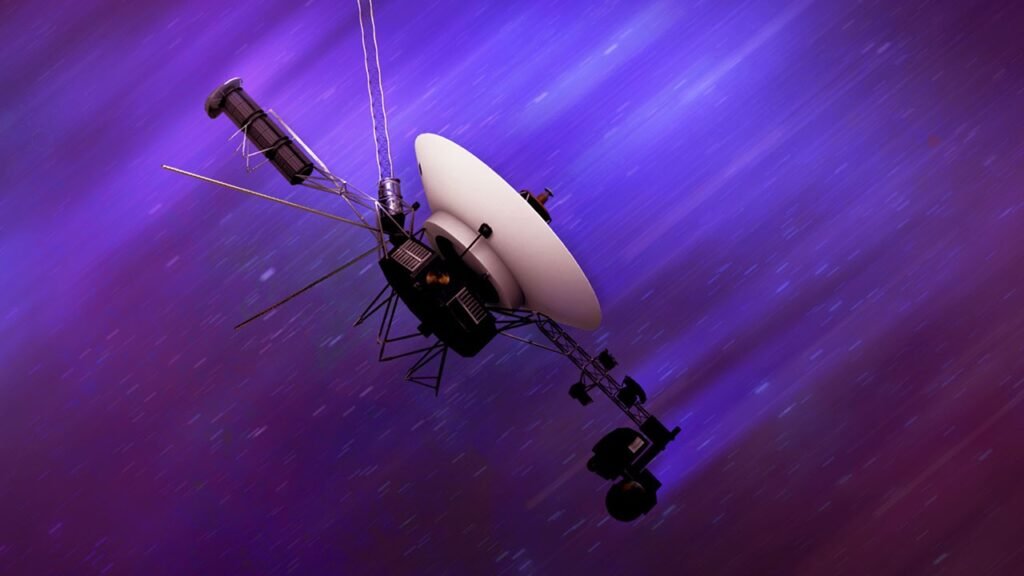
In 1977, NASA launched twin spacecraft Voyager 1 and 2, taking advantage of a once-every-175-year planetary alignment of the four largest planets in our solar system: Jupiter, Saturn, Uranus, and Neptune. Using six gravity assists between them, this Grand Tour gave us up-close views of the gas and ice giants, including several moons. By the 1980s, the two probes went their separate ways at Saturn. As Voyager 2 continued toward Uranus and Neptune, Voyager 1 grabbed one more portrait of the solar system (excluding Mercury and Mars), including a final image of the pale blue dot we call home.
NASA’s Voyager mission took advantage of a once-every-175-year alignment of the outer planets for a grand tour of the solar system. The twin spacecraft revealed details about Jupiter, Saturn, Uranus and Neptune – using each planet’s gravity to send them on to the next destination. Voyager set the stage for such ambitious orbiter missions as Galileo to Jupiter and Cassini to Saturn. Today both Voyager spacecraft continue to return valuable science from the far reaches of our solar system.
The Golden Record Cover
“Hello from the children of planet Earth.” Every good road trip needs some music to match. In this case, each craft carries the Golden Record, a 12-inch phonograph record with spoken greetings in 55 languages, 27 musical tracks, 116 images, and other sounds from Earth. Each record is protected by an outer cover featuring etchings showing our Sun’s location relative to 14 pulsars, along with instructions on how to play it. The design used various metals to protect the information encoded from space radiation: the record used copper and gold plating, and the cover used aluminum. The cover was electroplated with an ultra-pure sample of the isotope uranium-238. Uranium-238 has a half-life of 4.468 billion years.
Are We There Yet?
Did you know that a light-minute is a measure of distance, not time? In August 2012 and November 2018, Voyager 1 and 2 crossed the heliopause, the boundary where the Sun’s solar wind meets the interstellar medium. Using NASA’s Deep Space Network, Earth communicates with both spacecraft and tracks each on its journey. At the time of this article, the Canberra antenna tracked Voyager 1 at 25.80 billion km, or just over 16 billion miles.
On November 18, 2026, 49 years after its launch, Voyager 1 will cross the one-light-day mark, 16.1 billion miles from the Sun. You may have heard the term light-year in your favorite sci-fi movie or show, or when stargazing and referring to an object outside of our solar system.