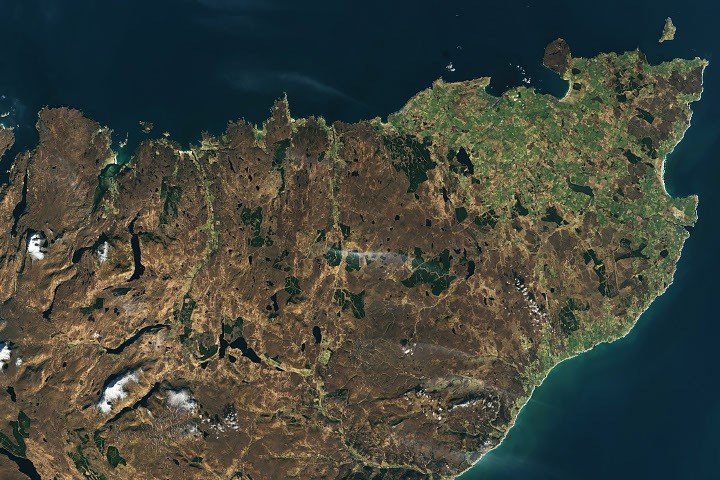
On March 4, 2024, the blanket bogs of the Flow Country in northern Scotland were showcased through imagery captured by the OLI (Operational Land Imager) on Landsat 8. Compared to ecosystems in many other parts of the world, these blanket bogs are unassuming, presenting as soggy, treeless landscapes dominated by hummocky mosses, grasses, and heathers. Yet, to ecologists, the seemingly desolate areas are nothing short of extraordinary because the bogs store tremendous quantities of carbon.
That is because their soils are so waterlogged that microbes cannot fully break down dead plant material, a process that would otherwise release carbon dioxide. Instead, partially decayed plant matter accumulates into thick layers of spongy, crumbly, carbon-rich material called peat. These unusual ecosystems, also called blanket mires and featherbed bogs, only occur in places with abundant rainfall, poor drainage, and low levels of evapotranspiration. These types of bogs cover just 120,000 square kilometers (46,000 square miles) globally, less than one-tenth of one percent of Earth’s land surface.
The image captured by Landsat 8 is centered on blanket bogs in the Scottish Highlands, home to the largest such ecosystem in Europe. This peatland is also the first of its type to be inscribed as a UNESCO World Heritage Site. The peat bogs of northern Scotland, home to more than 30 species of sphagnum moss, are spread across some 1,900 square kilometers (730 square miles) of the country’s Highlands region.
In the satellite image, boggy areas appear dark brown and are sprinkled with lakes. The light green area on the right side around Thurso is farmland, while the darker green geometric patterns in the center are conifer plantations. The image was captured in the spring, the part of the year when the land surface is most waterlogged and peat bogs begin to accumulate large amounts of new biomass.
While forests store most of their carbon in living trees, which eventually release it back into the atmosphere when they burn or die, peat bogs often store carbon for many thousands of years. Some parts of the Flow Country have been accumulating peat for more than 9,000 years, building deposits exceeding eight meters thick, according to UNESCO. Overall, scientists estimate that all of the world’s peatlands cover just 3 percent of Earth’s land surface but store more than 600 gigatons of carbon, which is about twice as much as all the world’s forests combined.