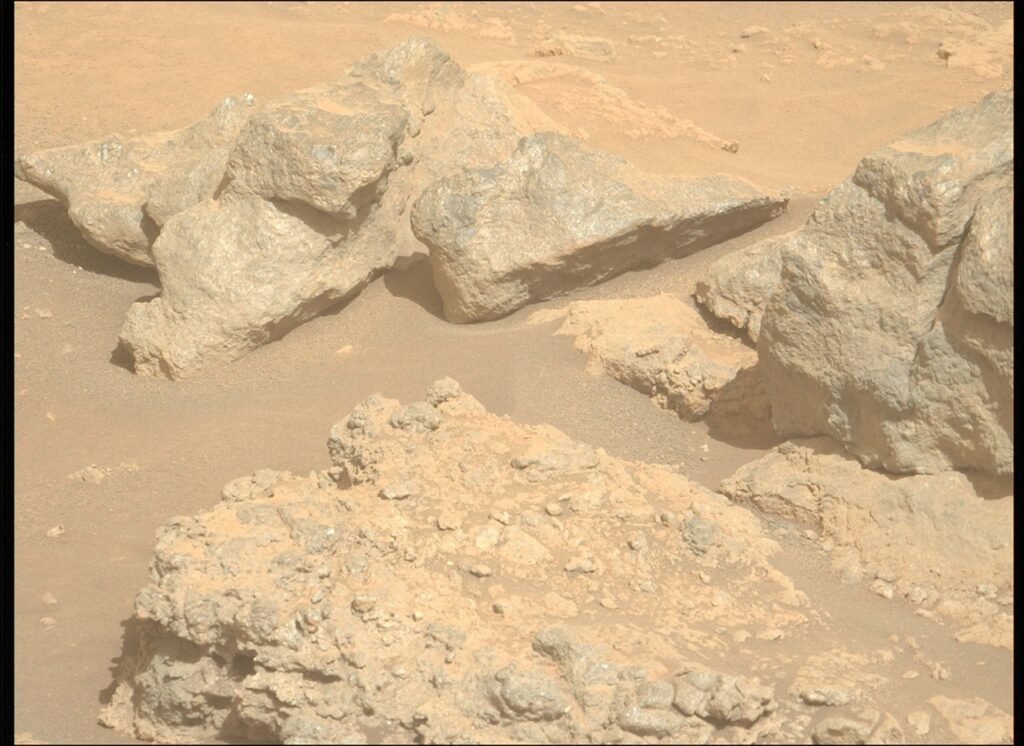
On Oct. 14, 2026, on Sol 2009 of the Mars 2020 mission, NASA’s Mars Perseverance rover captured an image of a potential contact between brecciated rock and higher-standing dark-toned rock at the “Tinga” target. The image was taken by the Mastcam-Z instrument’s left eye while the rover was driving across the southern border of the “Idubi” channel.
Previously, NASA’s Mars 2020 rover investigated the southern border of “Idubi,” an outcrop composed primarily of an igneous mineral geologists call olivine. During its traverse, the rover captured a geologic feature involving a contact between distinct rock types that could reveal the history of the region.
At the “Tinga” target, distinct geologic units are observed in close contact with one another. The lowermost unit is likely a polymict breccia, meaning it is made of many types of rocks and angular clasts. Breccia generally forms through violent geologic processes such as an impact event, and this particular breccia may have formed from an impact similar to the one that created Jezero crater, or even Jezero itself.
The higher-standing, dark rocks at “Tinga” could be associated with the nearby olivine-bearing unit at “Idubi,” which appears to extend onto the plains beyond the Jezero crater rim. Alternatively, these dark rocks may represent a part of the breccia that was heated, or “baked,” upon coming into contact with the hot rocks of “Idubi.”
Further in situ investigation of this outcrop is required to determine how the high-standing rocks observed at the contact relate to the broader unit. “Tinga” tells a tale about distinct geologic events that occurred just outside Jezero’s crater rim, and the Mars 2020 rover will continue to reveal Jezero’s origin story and geologic history.