NASA researchers are working to develop a battery that could function in the brutal cold of the Moon’s South Pole, where nighttime temperatures plunge to minus 328 degrees Fahrenheit (minus 200 Celsius). For future lunar operations, a battery will need to work immediately when warmed up and be able to power everything from an astronaut’s emergency kit to a rover capable of exploring the Moon’s darkest craters — all without posing a fire hazard. A team of NASA researchers is working to make all that happen through the Solid Power for Extreme Environment Adaptability and Resilience in Space (SPEARS) project, which could provide an important tool to help power humanity’s sustained presence on the Moon through the Artemis campaign.
“Batteries have become an important part of our lives here on Earth, which enable our laptops, cell phones, power tools, and even our vehicles,” said Donald Dornbusch, principal investigator for SPEARS at NASA’s Glenn Research Center in Cleveland, where the project is led. “We will need them on the Moon, too, and these batteries will be required to operate reliably and safely in this harsh environment. That’s why we’re working on this technology.”
How solid-state batteries solve lunar temperature problems
Traditional lithium-ion batteries like those in cell phones and laptops rely on liquid electrolytes. Cool a conventional battery to the Moon’s nighttime temperatures, and that liquid would freeze, potentially damaging the battery. Heat it up too much — say, to daytime lunar temperatures of 212 F (100 C) — and it won’t work until cooled. Expose the liquid to the vacuum of space, and it evaporates. SPEARS batteries solve these problems by replacing the liquid electrolyte with a solid ceramic- or polymer-based material.
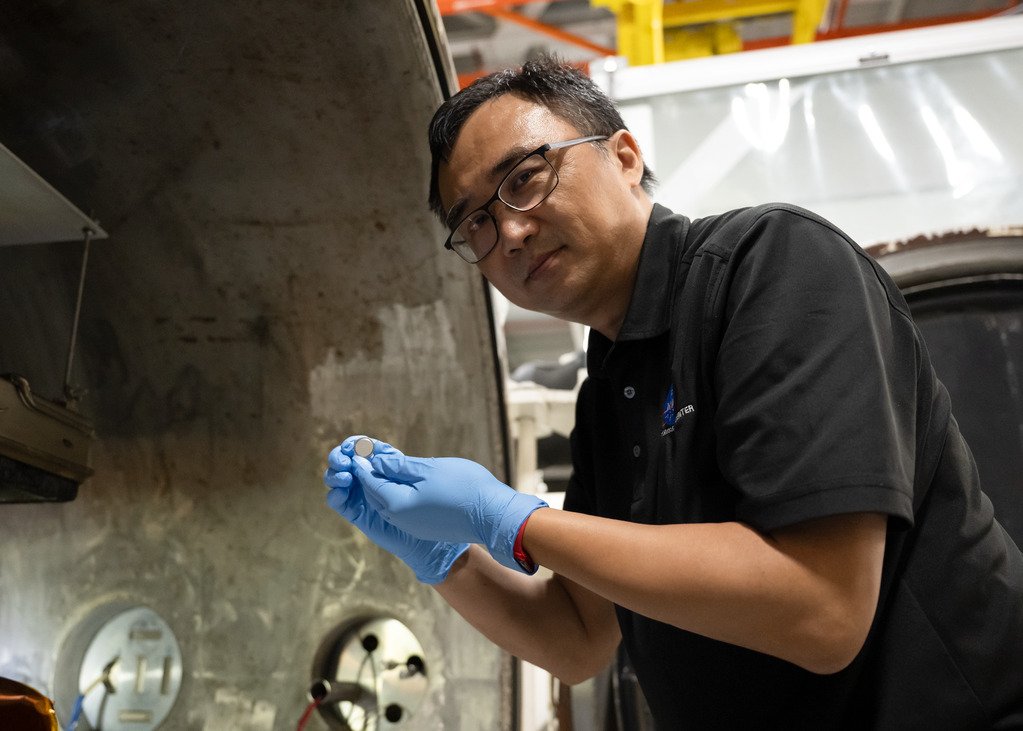
During recent thermal vacuum testing at NASA’s Langley Research Center in Hampton, Virginia, small prototype battery cells operated well up to 176 F (80 C), down to minus 76 F (minus 60 C), and with slightly reduced performance down to minus 112 F (minus 80 C). “We proved for the first time that these cells can work down to minus 80 degrees Celsius,” said Yi Lin, SPEARS testing and research lead at NASA Langley.
Testing durability and extreme conditions
The thermal vacuum testing showed that after exposure to temperature extremes from 212 F (100 C) to minus 274 F (minus 170 C), SPEARS batteries don’t sustain damage. Not even solid-state batteries will function while they’re at a temperature as low as minus 274 F, but because solid electrolytes don’t freeze like a liquid, the batteries can survive the extreme low temperatures.
In order to get the batteries working again after exposure to such cold, small heaters come into play. SPEARS batteries wouldn’t need to be kept warm all the time, just warmed up to operational temperature. That could reduce the need for heavy thermal management systems in spacecraft and lunar habitats, allowing for lighter designs, lower costs, and longer mission durations.
Applications for space and Earth
The applications for these solid-state batteries range from small tools like drills that must operate in shadowed lunar craters, to rovers and emergency power packs for astronauts, alongside long-duration scientific instruments. “We can tune the chemistry by using different electrode materials,” said Lin. “Just like the chemistry in your earbuds is different from the chemistry in your phone, which is different from the chemistry in your car, all these chemistries can still function with a solid electrolyte. We can tune for energy, tune for power, tune for durability, depending on the application.”
While SPEARS is designed for space, the technology could be spun off into Earth-based applications. “The potential market for solid-state batteries is very broad,” said Ji Su, a polymer materials scientist and the task lead at NASA Langley. “Automobiles, cell phones, communication devices, drones — anything that needs a portable power supply.”
The SPEARS project began in 2026 with funding through the Advanced Research and Technology division within the agency’s Research and Technology Mission Directorate. NASA’s Ames Research Center in California’s Silicon Valley is working to develop flight hardware such as test boards and electronics to help prepare the SPEARS batteries for spaceflight and test them in space environments.