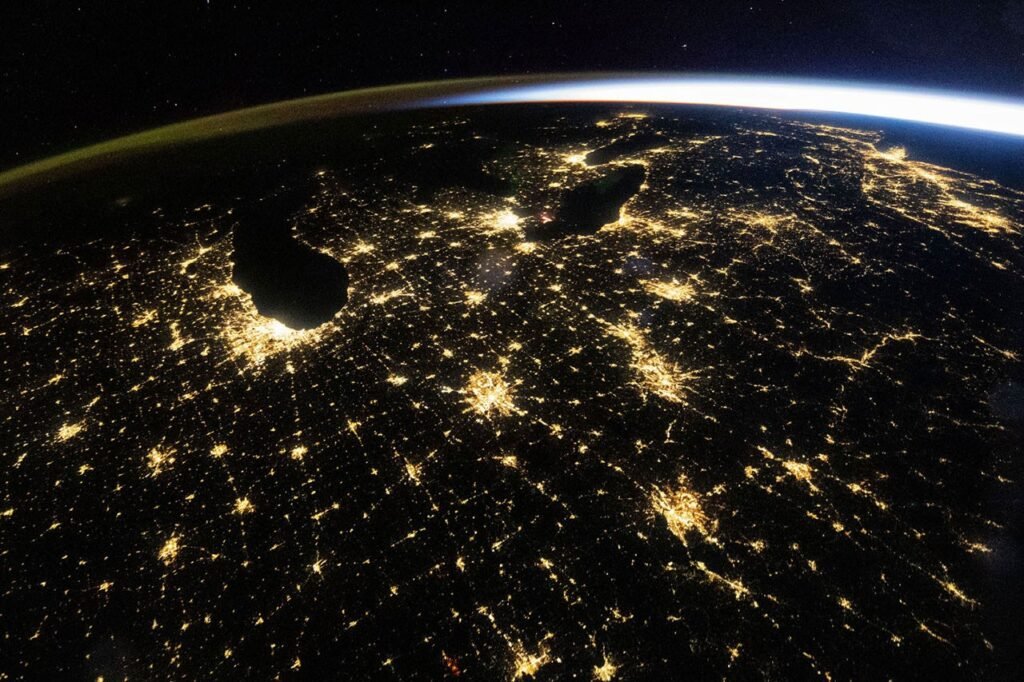
An astronaut aboard the International Space Station captured a wide-angle photo of the eastern United States during the predawn hours of Oct. 18, 2026, at 4:54 a.m. Central Daylight Time (09:54 Universal Time). Under clear skies, illuminated cities across the U.S. Midwest—including Chicago, Illinois, and Detroit, Michigan—stood out as some of the brightest features across the darkened landscape.
Mid-sized cities such as Indianapolis, Indiana; Cincinnati, Ohio; and Louisville, Kentucky, along with their interconnections along state and interstate highways, also shined brightly in the imagery. Above the web of nighttime lights and lower atmosphere, a diffuse layer of green and orange airglow appeared along the horizon to the left, produced when sunlight strikes atoms and molecules in the upper atmosphere and causes them to eject photons. To the right, solar light arced across the horizon roughly an hour before sunrise on the East Coast and about two hours before sunrise in Chicago.
Astronaut photos and remote sensing observations of nighttime lights provide scientific value by tracking changes in the built environment. While Chicago’s lightscape appears as a homogeneous pale yellow in the wide view, detailed imagery reveals a range of colors stemming from different types of lighting. Using NASA’s extensive Gateway to Astronaut Photography of Earth archive, researchers developed a method for distinguishing lighting types within pixels to systematically quantify urban lights’ brightness, color, and extent to provide insight into city growth.
In addition to astronaut photography, NASA’s Black Marble nighttime lights product suite uses satellite observations to produce science-quality records of nighttime lights across the globe at daily, monthly, and yearly time scales. In the eastern U.S., scientists have used these data to track power outages and restoration following major storms, lighting changes associated with new infrastructure, and transitions to LED lighting from older forms.
The Oct. 18, 2026 photograph (ISS075-E-226709) was acquired by Expedition 75 crew members using a Nikon Z9 digital camera with a 14-millimeter focal length. A detailed photograph taken on March 1, 2024 (ISS070-E-105097) was acquired by Expedition 70 crew members using a Nikon D5 digital camera with a 400-millimeter focal length. Both images were provided by the ISS Crew Earth Observations Facility and the Earth Science and Remote Sensing Unit at NASA Johnson Space Center, with processing applied to crop, enhance contrast, and remove lens artifacts.