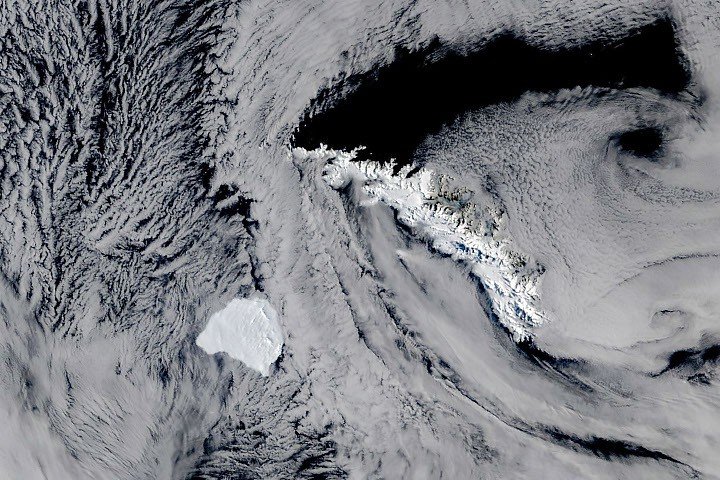
Iceberg A-81 has reached the remote island of South Georgia in the South Atlantic Ocean, according to satellite imagery acquired on October 20, 2026. The iceberg, which measures approximately 1,550 square kilometers (600 square miles), appears to be bumping along the edge of the island’s shallow underwater shelf, causing its progress to slow noticeably.
The berg originated from the Brunt Ice Shelf, breaking away in January 2023 after a period of instability in a rift known as Chasm 1 that began growing around 2012. Following its separation, the iceberg spent more than three years traveling through the Weddell Sea, carried by the clockwise-flowing Weddell Gyre. By May 2026, it reached the tip of the Antarctic Peninsula before moving north into the Scotia Sea.
The current location of the iceberg is 2,300 kilometers (1,400 miles) north-northwest of the Brunt Ice Shelf. Observations of the berg’s interaction with the shelf were noted by Jan Lieser of Australia’s Bureau of Meteorology and Christopher Shuman, a retired scientist from the University of Maryland.
South Georgia has previously impacted the movement of large icebergs. In 2025, Iceberg A-23A ran aground on the same shelf before eventually breaking apart. Scientists continue to monitor the Brunt Ice Shelf, which has experienced several significant calving events in recent years, including the release of Iceberg A-74 in 2021 and Iceberg A-83 in 2024.
The Brunt Ice Shelf is also the location of the British Antarctic Survey’s Halley Research Station, which has served as a center for atmospheric, space, and Earth science research since the 1950s. While Iceberg A-74 has since disintegrated, Iceberg A-83 remains intact and is currently following A-81 on a northward path, accompanied by other icebergs exiting the Weddell Sea.