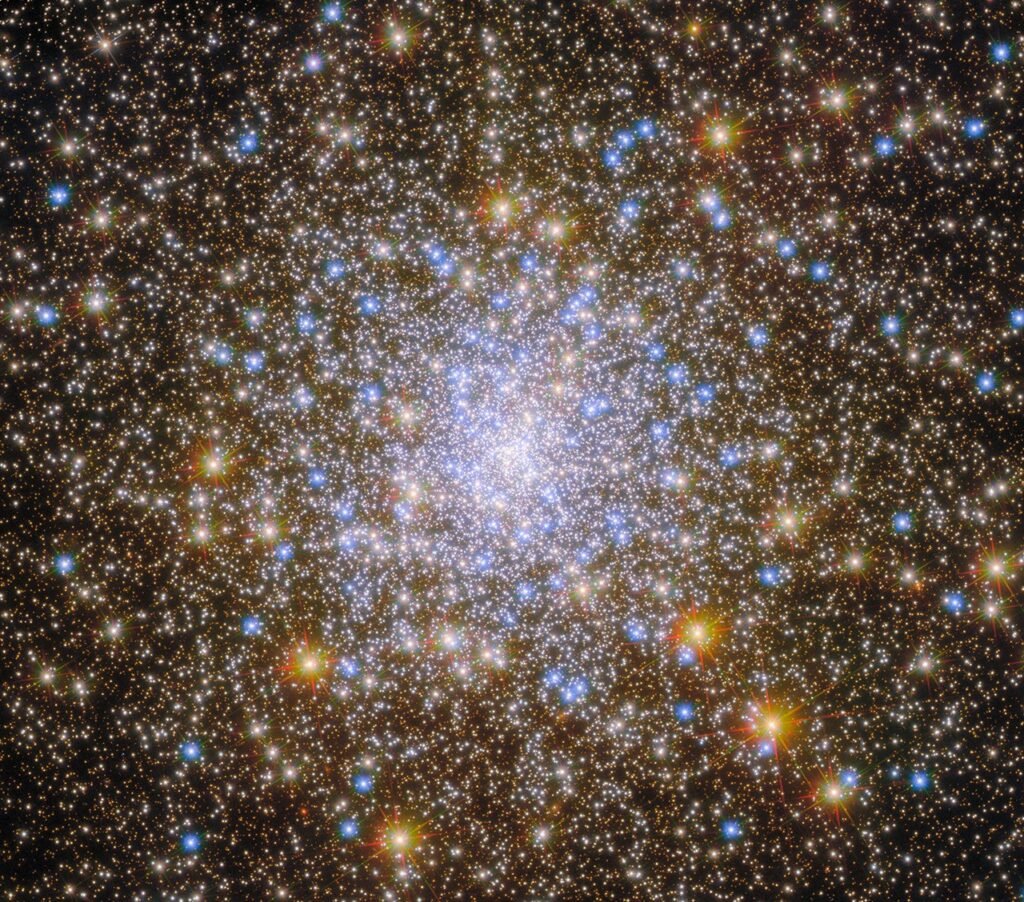
A composite image from the Hubble Space Telescope featuring the globular star cluster Messier 30, located about 27,500 light-years away in the constellation Capricornus, is providing astronomers with insights into galactic history. Also designated as NGC 7099, the cluster contains tens of thousands to millions of stars in a roughly spherical grouping.
Messier 30 was named after the French astronomer Charles Messier, who cataloged diffuse objects that could be mistaken for comets in early telescopes. Globular clusters generally reside on the outskirts of galaxies, orbiting within a vast, diffuse halo region like a swarm of moths around a lightbulb. The Milky Way galaxy contains at least 150 globular clusters, with the nearest located approximately 6,000 light-years away. Astronomers estimate the ages of these clusters range from 11.5 to 13.5 billion years, making certain globular clusters nearly as old as the universe itself.
Globular clusters have long served as tools for understanding the galaxy. More than a century ago, astronomer Harlow Shapley used observations of a particular type of variable star to measure the locations of and distances to dozens of globular clusters in the galaxy. His work demonstrated that the Sun is not at the center of the galaxy and that the galactic center lies toward the constellation Sagittarius. Although Shapley’s distance measurements were incorrect, leading him to conclude that the galaxy was about twice as large as its actual size, globular clusters continue to provide clues about galactic development.
While globular clusters formed within the Milky Way can act as time capsules that preserve the original chemistry of the young galaxy, researchers discovered that Messier 30 and several other globular clusters orbit in the opposite direction from the galaxy’s spin. This counter-rotation suggests that these clusters may not have formed within the Milky Way, but were instead captured by the galaxy in the distant past.
Hubble has observed Messier 30 across multiple research initiatives over the years. An earlier observing program (#10775; PI: Sarajedini) utilized Hubble’s Advanced Camera for Surveys (ACS) to survey dozens of Milky Way globular clusters in red and near-infrared light, detecting stars down to 20% of the mass of the Sun.
A subsequent program (#13297; PI: Piotto) returned to Messier 30 and other globular clusters using Hubble’s Wide Field Camera 3. This effort used three filters to capture bluer light, collecting data critical for studying exotic objects such as “blue straggler” stars and investigating the multiple star populations that can inhabit a single globular cluster.
More recently, an observing program (#16298; PI: Libralato) used Hubble’s ACS to view many of these globular clusters again. This research tracked how different populations of stars in globular clusters moved over the 15 years since Hubble first observed them. The composite image of Messier 30 incorporates data from all three observing programs, combining ultraviolet, visible, and near-infrared light to analyze how these star groups formed and evolved.