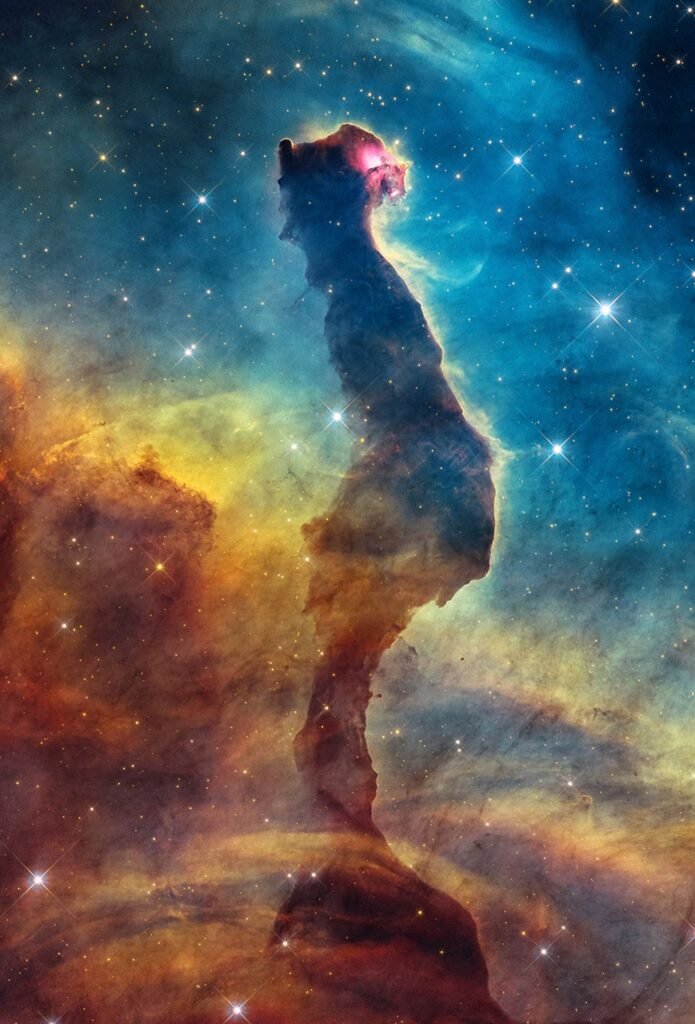
NASA’s Hubble Space Telescope and James Webb Space Telescope have captured complementary views of the Cat’s Head Nebula, a dynamic star-forming region located about 7,500 light-years from Earth within the vast Carina Nebula.
The small area observed by both observatories earned its nickname due to its resemblance to a cat sitting with its back turned toward the viewer, with its head turned to the right to reveal a glowing eye. Although the Cat’s Head Nebula is a temporary cosmic scene that will eventually disperse as stars form and evolve over time, the region provides critical information to help astronomers understand the complex and chaotic process of star formation.
The distinctive shape of the nebula was likely sculpted over time by intense ultraviolet radiation and stellar winds from massive stars in the Carina Nebula. As this stellar feedback erodes surrounding gas and dust, denser material within the feline-shaped pillar resists erosion.
Hubble’s visible-light view reveals an opaque, dark brown pillar of dust edged by a luminous rim of gas. The cat’s glowing red eye in this view may indicate a young star still partially embedded in dust, while a ridge of hazy yellow follows the edge of the filament’s right side. This bright rim is consistent with gas illuminated and ionized by ultraviolet radiation from nearby massive stars, potentially driving a process known as photoevaporation. The diffuse material surrounding the pillar glows blue and cyan at the top, shifting to yellow, orange, and red toward the bottom. Hubble’s filters capture light emitted by oxygen, hydrogen, and sulfur, alongside starlight scattered by dust.
Webb’s near-infrared and mid-infrared images provide additional details that expand on Hubble’s observations. In near-infrared light, the filament becomes more transparent, exposing its surface structure and ghostly wisps of dust and gas on the cat’s left side. Webb’s near-infrared view shows a dense scattering of blue and yellow stars, some still enshrouded in dust, and a glowing yellow eye that may be an embedded young star. The high-resolution imagery also captures faint background galaxies visible through the Milky Way galaxy.
In mid-infrared light, emissions from warm dust and carbon-based molecules excited by starlight outline intricate structures, including delicate globules and strands to the left of the pillar. To the right of the pillar, a bright light source shown as yellow represents a likely infant star embedded in dust against reddish emissions from surrounding material. A narrow filament appears to cross the light source, though the image alone cannot establish whether the two are physically connected.
Hubble, which has been operating for more than three decades, is an international cooperation project between NASA and ESA (European Space Agency). Mission operations are managed by NASA’s Goddard Space Flight Center in Greenbelt, Maryland, with support from Lockheed Martin Space, while science operations are conducted by the Space Telescope Science Institute in Baltimore, operated by the Association of Universities for Research in Astronomy. The James Webb Space Telescope is an international program led by NASA alongside partners ESA and the Canadian Space Agency (CSA).