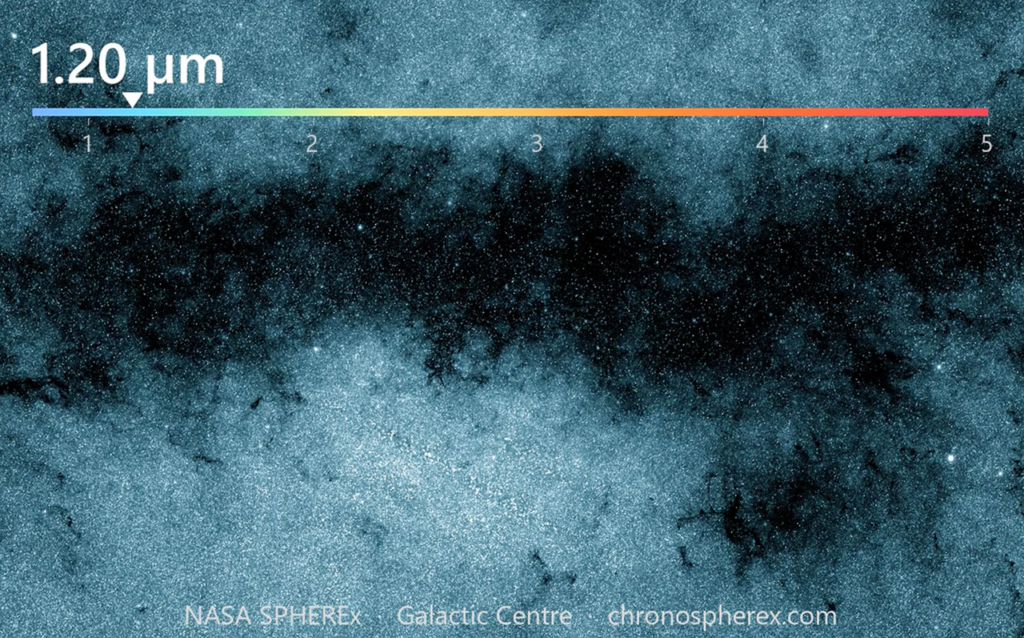
On Nov. 25, 2026, space science data gathered by NASA’s SPHEREx satellite highlighted how different wavelengths of infrared light can reveal or obscure the center of the Milky Way galaxy. Over its 13 billion years, the Milky Way has accumulated large amounts of dust that block views of the Galactic Center in certain spectrums.
Cosmic dust differs significantly from household dust found behind a couch, which is composed of skin cells, dirt, pollen, and other debris. Instead, cosmic dust particles are hundreds of times smaller and consist of tiny compounds of oxygen, carbon, and other elements released into space when a star dies.
Observations from the SPHEREx satellite feature infrared light gathered from the center of the galaxy, with false colors corresponding to infrared wavelengths displayed in the top left of the video. In the near-infrared spectrum, such as at 1.2 microns, light is absorbed and scatters off dust particles, leaving the Galactic Center almost entirely blocked by clouds of dust.
In contrast, light in the mid-infrared spectrum is able to pierce through the cosmic dust and reach the SPHEREx satellite. Scientists note that this behavior is similar to, though not exactly the same as, the process that causes sunsets to appear red.
The data behind the imagery was provided by NASA/IPAC IRSA and NASA/JPL-Caltech SPHEREx. Image processing was conducted by The Bright Nobles (Muhammet Mücahit Soylu, Serdar Aydın, Furkan Küpeli) and ChronosphereX (chronospherex.com). The material was authored and edited by Keighley Rockcliffe, Robert Nemiroff, Jerry Bonnell, and Cecilia Chirenti as a service of the Astrophysics Science Division (ASD) at NASA’s Goddard Space Flight Center (GSFC), NASA Science Activation, and Michigan Technological University. The following day’s feature promised a sandy view of the Milky Way.